Posts

Showing posts with the label smartphone

What UX is and why your company cannot live without it?

Most of IT companies don’t see UX (User Experience) should be at the heart of everything they do which leads to their inability to present and sell UX as the starting point of any project. UX in most case is sold as an “extra” service while they should be seen as the starting point of any IT business strategy. UX is everything - it starts with the customers, go deeper to their customers and it should end with them in mind! What UX really is? UX is a business and digital field in itself. The misconception here is that most people think of UX as just usability. Usability though is simply how easy to use and simple the website functionalities are to the end user. For usability we have plenty of best practices already in place and even standardized. Bear  in mind that usability is only part of UX! UX is a continuous work that starts by what customers want to accomplish with their site, and not how they want the site to be , unless they are the ultimate end user of the site...
The Myth of HTML5 and How It's Misunderstood

HTML5 MISCONCEPTION Nowadays any new browser capability or web application technique found across the web is labeled as HTML5 and that is not true. Michael Mahemoff said that HTML5 has become a brand that represents a new type of web application rather than the specification itself. In order to learn HTML5 is very important to understand what really HTML5 is. It is common nowadays hear CSS transitions, web sockets, geolocation, SVG, CSS @font-face all mentioned under the HTML5 banner and label all under HTML5 "brand".  In the specification none of those mentioned are found for the simple reason that they either belong to the CSS3 specification or other API specification within the WWW Consortium. Websites are and will be built with a combination of HTML5, next-generation APIs, JavaScript and CSS3, which means that as a designer or developer the difference between those technologies must be clear and how they fit together should be understood. What is really HTML5? ...

REAL USABILITY MATTERS

REAL USABILITY MATTERS - Usability is one of the single most important thing you can do to ensure success and money. Any design should have the user in mind, however when we talk about small screens this is a must. The Google presentations  What is a mobile site and why do you need one?  try to give business people and even developers the awareness that mobile sites nowadays is a must - but if they are build without the user in mind there is not use to have it. Their case studies are interesting. Mobile-friendly web apps help businesses: To connect with their customers Increase Revenues Reduce Costs because when sites are optimised and user-friendly you give your customers means to get what they want instead of wonder around, get tired and go to your competitor. The catch is that the only way to accomplish that is to invest in Usability. IT IS ALL ABOUT USABILITY. Improved usability makes you INCREASE YOUR MARKET SHARE - the like effect...
Image
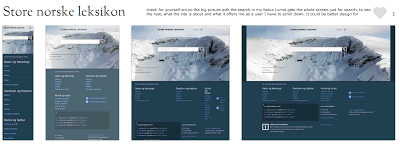
THE REALITY OF RESPONSIVE DESIGN TO THE MOBILE SCREEN (The mobile analysis was done based on the sites presented on  mediaqueri.es .) Here you can see how responsive design are great for some desktop and tablets but might be a bad choice to communicate what your business is and what the user can do in the tine mobile screen. Check for yourself snl.no the big picture with the search in my Nokia Lumia gets the whole screen just for search, to see the rest, what the site is about and what it offers me as a user I have to scroll down. It could be better design for mobile, but this is a good responsive design for desktop and tablets. Another one is Suffandnonsense.co.uk the image when you open is the whole screen, to see what the site is about I have to scroll down. It could be better done for mobile but it is very good for desktop and tablets. You can check for yourself on your mobile all of the sites - this is good exercise to see that pictures might speak m...

RETHINKING THE MOBILE WEB presentation by Bryan Rieger

This is a Slideshow RETHINKING THE MOBILE WEB by by Yiibu Author: Bryan Rieger (September 10, 2010)

WHY AREN’T MOBILE WEB DEVELOPERS DOING THEIR JOB?

I came across a very interesting website quirksmode.org in the Mobile section that explain beatifully in many parts what I believe that is the problem with mobile web design nowadays. I will be copying what I think is the most important points here. Some I might discuss but you will understand the probem when you read it. MOBILE WEB DEVELOPERS DOING THEIR JOB? The unique selling point of the web is that it runs on all devices; and not just on one platform. But it seems mobile web developers aren’t much interested in reaching out beyond one or two specific platforms. Developers should reach out to as many paltforms as humanly possible instead of confining themselves to the best ones. WHY ARE WEB DEVELOPERS INTERESTED IN MOBILE SO RELUCTANT TO VENTURE OUT BEYOUND THEIR iPHONE CONFORT ZONE? Mobile web projects for large companies are based on requirements written last year, during the height of the iPhone obsession. In addition, the iPhone’s share of mobile web traffic remains...

RESPONSIVE DESIGN TEMPLATE FRAMEWORKS. ARE THEY ANY GOOD?

Image
Yes, responsive design frameworks are a good thing but it all depends on your website. Remember there is no one solution for all and if you can use a framework to make a responsive design for all it will depend if you have a content base site and if your site is not "user-specific interaction dependent". I have watched the Sitefinity webinar (embbedded below) and the tool is very useful for creating Responsive Design and even mobile that is content base such as magazines, newspapers and any other website that does not require the user to do a specifc thing on the site. The added bonus on the tool is that the user edit blocks of layout template that is not table based and their text clean out any style done by text processors - this is a tool build with the user experience in mind. However as Sitefinity presenter said himself at the end of the webinar "Responsive Design is not a complete solution..., there is still a lot of granulatity..." You can hear ...

Why responsive design is not good for Smartphones?

Smartphone is a mobile device in which people does not have time or are in the environment that is suitable to input anything. This means the more you facilitate your customers to do what he or she has to do on your mobile Web site the more they will come for more, stick with your company and even recommend your company for the easy of use even when mobile. What is the user experience you provide for your customers on your mobile Web? If you use responsive design, what do you consider when building the Smarthphone version? Do you ask your customers what they need and what when using the Smartphone or you do what you think is best without considering the users who will be using the site? without considering their environment conditions and what they really would like to use your site for when mobile?